Having worked inside China’s hospitality industry, I can tell you the travel ecosystem here looks very different from the West. Booking.com and Expedia barely register; instead, a handful of homegrown giants and super-apps run the show. Knowing who’s who helps you book smarter — and understand why things work the way they do.
The online travel agencies (OTAs)
This is where most trips are booked, and it’s dominated by domestic players:
- Trip.com Group (携程) — the 800-pound gorilla. It owns Ctrip (the domestic brand), Qunar, Skyscanner, and the international Trip.com. For foreigners, Trip.com is the one to use: English, foreign cards, and it can issue train tickets without a Chinese ID.
- Meituan (美团) — the everything-app that quietly became a travel giant, huge for hotels and local deals (and food delivery).
- Fliggy (飞猪) — Alibaba’s travel arm, plugged into Alipay.
- Tongcheng (同程) — strong in lower-tier cities, deeply integrated with WeChat.
Foreign OTAs exist but have tiny market share — locals simply don’t use them.
The hotel groups
China has some of the world’s largest hotel companies, and you’ll stay in their brands constantly:
- Jin Jiang International (锦江) — one of the biggest hotel groups on Earth; owns Vienna, 7 Days, and even France’s Louvre Hotels.
- H World / Huazhu (华住) — runs Hanting, Ji Hotel, Crystal Orange and operates Mercure/Ibis in China.
- BTG Homeinns (首旅如家) — the Home Inn budget empire.
- Atour (亚朵) — the design-led darling punching above its price. See our hotel guide and recommended hotels.
The airlines
Three giant state-owned carriers plus challengers:
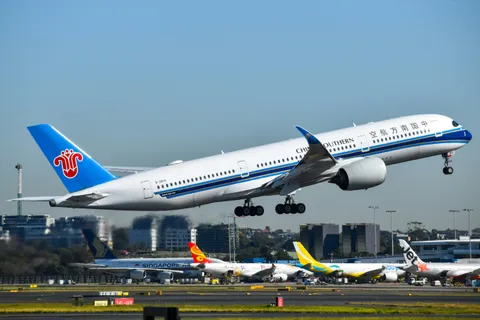
- Air China, China Eastern, China Southern — the “big three.” See airlines that fly to China.
- Hainan Airlines — the best-rated, privately rooted carrier.
- Spring Airlines — the no-frills budget pioneer.
The rail monopoly
There’s only one player: China State Railway Group, via the official 12306 platform. Everything else (including Trip.com) books on top of it. The high-speed network is the backbone of domestic travel — see our rail guide.
The super-apps & discovery layer
Here’s the part outsiders miss: in China, discovery and payment are inseparable from travel.
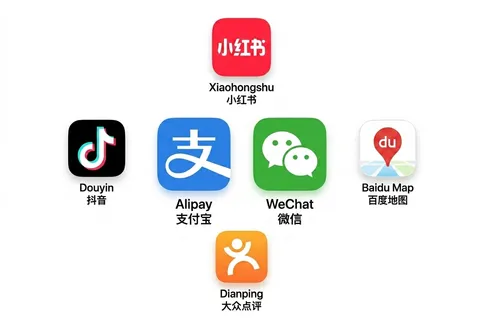
- Alipay & WeChat — not just payments; both contain mini-programs for ride-hailing, tickets, metro and travel. See payments.
- Xiaohongshu (小红书 / RED) — where Chinese travellers actually plan, sharing detailed, photo-rich guides. Increasingly the real “TripAdvisor” of China.
- Douyin (抖音) — China’s TikTok; a single viral clip can flood a small town with tourists overnight.
- Dianping (大众点评) — the Yelp for restaurants and attractions.
These are covered in our must-have apps guide.
What it means for you
- Book through Trip.com for flights, trains and hotels in English — it sits on top of the same inventory locals use.
- Stay with the big chains (Jin Jiang, Huazhu, BTG, Atour) for reliable, foreigner-friendly check-in.
- Use Xiaohongshu and Dianping to find what locals love, not just what’s marketed to tourists.
- Expect everything to live inside an app — the Chinese travel industry is mobile-first to a degree the West hasn’t reached.
Once you see the landscape, China’s travel machine stops feeling foreign and starts feeling like the most efficient one you’ve used.