A convenience store on the corner — and a big supermarket in the basement of the nearest mall — quietly solve half a traveller’s daily problems in China: bottled water, a quick hot meal, a phone charger you forgot, snacks for the train, beer for the hotel room. They’re clean, everywhere, fixed-price (no bargaining), and you pay the same way you pay for everything else here: a QR scan. Here’s how to use them.
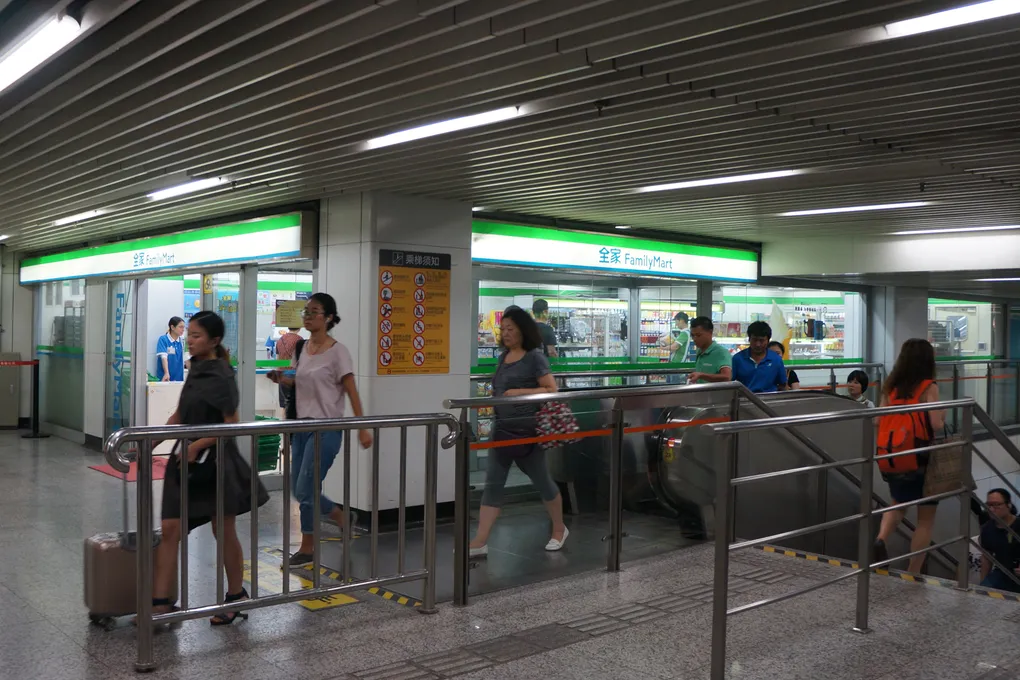
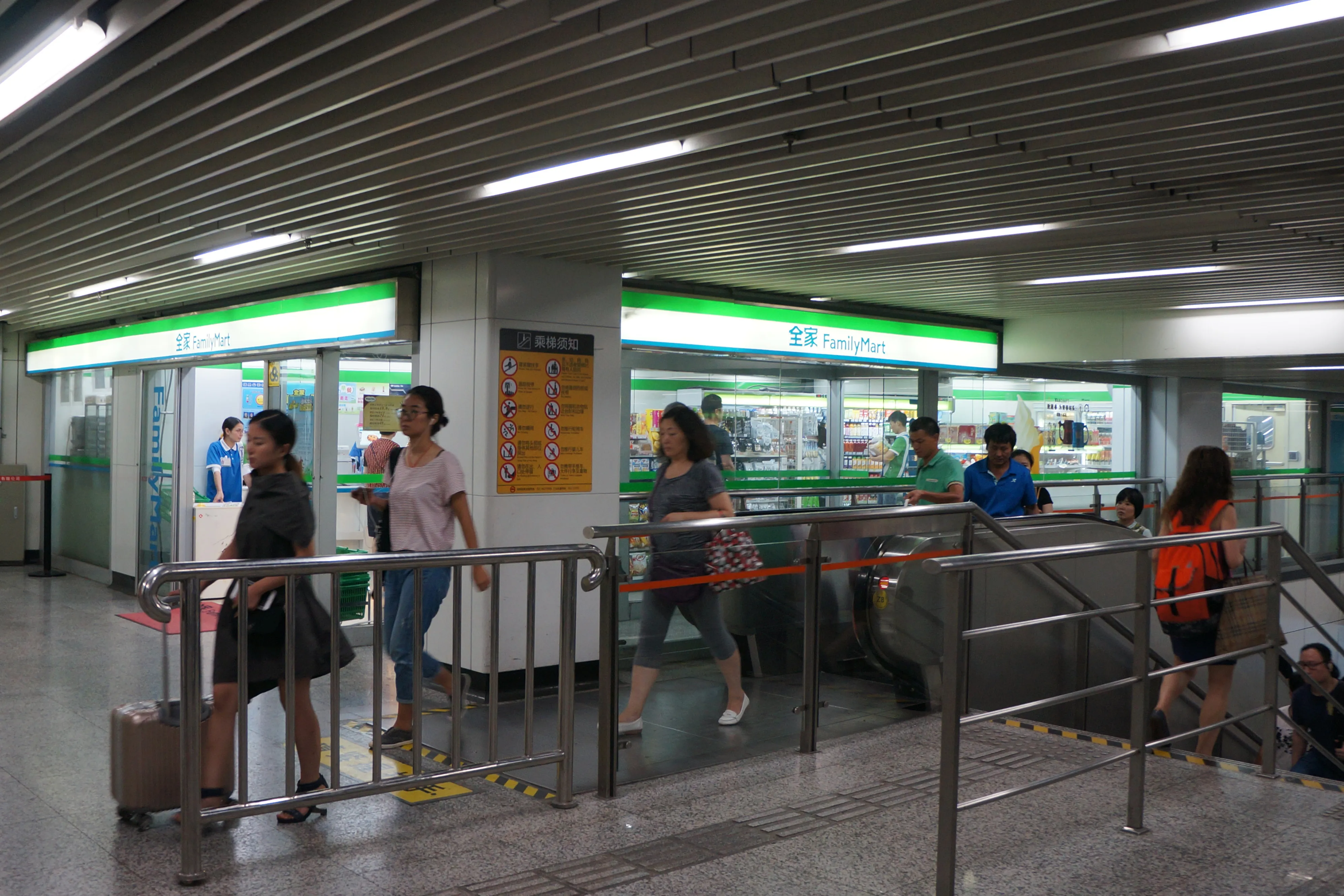 A FamilyMart right inside a Shanghai metro station — convenience stores cluster around stations, so you’re rarely more than a block from one. Photo: MNXANL (Wikimedia Commons), CC BY-SA 4.0.
Convenience stores (便利店, biànlìdiàn)
Small, often 24-hour shops packed into metro stations, office towers and residential streets. The single best feature for travellers is hot ready-to-eat food: steamed buns (包子), tea eggs (茶叶蛋), oden skewers in broth (关东煮), rice balls, microwave bento boxes, fresh coffee and milk tea. Staff will heat anything for you, and most stores have a hot-water dispenser so a ¥5 cup of instant noodles becomes a real meal.
The big chains
- FamilyMart (全家, Quánjiā) — Japanese-style, excellent hot-food counter and bakery. Strongest in Shanghai and the east.
- Lawson (罗森, Luósēn) — the other Japanese giant; famous for desserts and limited-edition snacks. Big in Shanghai, Wuhan, Chongqing, Beijing.
- 7-Eleven (7-11) — reliable hot food and Slurpees; widespread in Guangdong, Beijing and Chengdu.
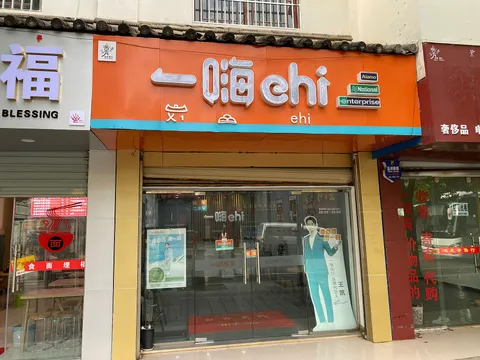
- Meiyijia (美宜佳) — China’s largest chain by store count (tens of thousands of outlets). More bare-bones than the Japanese trio — drinks, snacks, daily essentials — but absolutely everywhere, especially in the south.
- Regional players you’ll also bump into: Bianlifeng (便利蜂), app-driven self-checkout stores in Beijing; Hongqi (红旗) all over Sichuan/Chengdu; Today (今天) in Wuhan.
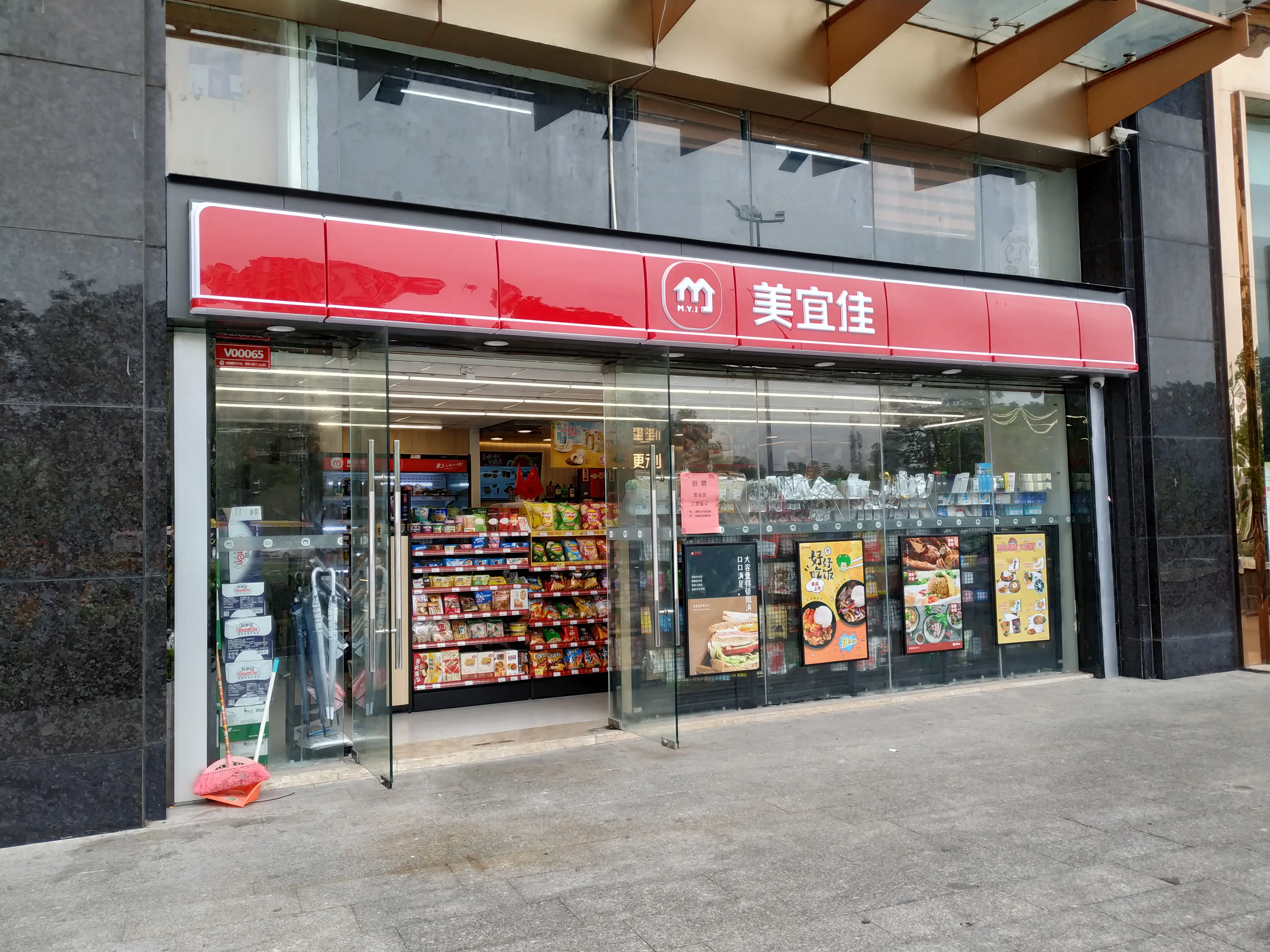 Meiyijia is China’s biggest convenience chain by store count — homegrown, no-frills and on practically every corner in the south. Photo: TuxStrikesBack (Wikimedia Commons), CC BY-SA 4.0.
| Chain | Look for | Best for | Typically 24h? |
|---|---|---|---|
| FamilyMart 全家 | Green/blue/white | Hot food, bakery | Yes (big cities) |
| Lawson 罗森 | Blue milk-bottle logo | Desserts, snacks | Yes (big cities) |
| 7-Eleven | Red/green/orange | Hot food, drinks | Yes |
| Meiyijia 美宜佳 | Red “m” logo | Drinks, basics, sheer ubiquity | Often until late |
Supermarkets (超市, chāoshì)
For a bigger shop — fruit, drinks by the case, instant-noodle variety, toiletries, a SIM top-up, local snacks to take home — head to a supermarket. In cities they’re usually on the basement floor (B1/B2) of a shopping mall, often next to the food court.
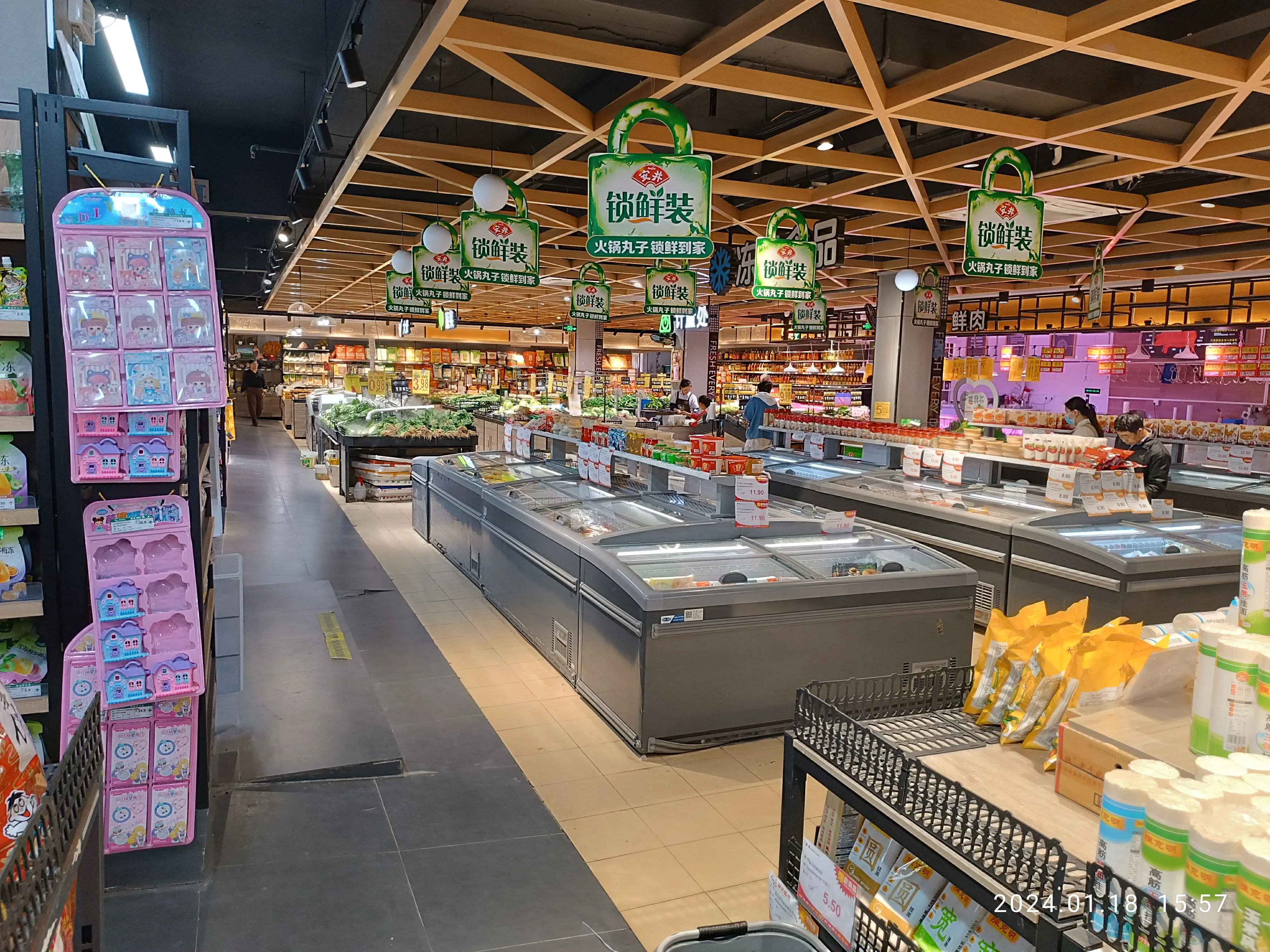 A typical mid-size Chinese supermarket — fresh produce, chest freezers and a wall of snacks. Photo: Singkabee Liam H Tonga (Wikimedia Commons), CC0.
- Hypermarkets: RT-Mart (大润发), Walmart (沃尔玛), CR Vanguard / Vanguard (华润万家), Yonghui (永辉), Wumart (物美) in the north. Big, cheap, one-stop.
- Membership warehouses: Sam’s Club (山姆) and Costco (开市客) are hugely popular in tier-1 cities. You need a membership (≈¥260/year), so they’re worth it only for longer stays — but the Sam’s Club app lets you order for delivery without going in.
- “New retail” fresh stores — Hema / Freshippo (盒马): Alibaba’s app-based supermarket and a genuinely fun experience. Scan barcodes with the Hema app, pay through Alipay, and they’ll deliver to your hotel in ~30 minutes if you’re within 3 km. Many branches have a seafood counter that cooks your pick on the spot. Note it’s app-and-Alipay only — there are no cash registers in the usual sense.
- Delivery to your door — JD Daojia (京东到家): JD’s on-demand app doesn’t run its own shops — it delivers from the supermarkets already near you (Walmart, CR Vanguard, Yonghui and many more) straight to your hotel in about an hour. Handy for stocking up on water, drinks and snacks without leaving your room. Rivals that do the same thing: Meituan’s instant grocery (美团, now branded 小象超市 / Xiaoxiang Supermarket) and Dingdong Maicai (叮咚买菜), which runs its own fresh-grocery delivery in the bigger eastern cities. All are app-based, so they’re easiest once your phone is set up with a Chinese payment method.
How to pay (and other practicalities)
- Payment: scan to pay with Alipay or WeChat Pay — universal. Large supermarkets (Walmart, Sam’s) increasingly take foreign credit cards at staffed lanes, but don’t count on it elsewhere. Self-checkout machines are usually Chinese-only, so just use a staffed lane if you’re unsure.
- Bags cost extra (a few jiao). Bring a tote or buy one at the till.
- No tipping, no bargaining — prices are fixed. Save the haggling for markets.
- Hours: convenience stores in big cities are often 24/7; supermarkets typically run ~8–9am to 10pm.
- No public toilets. Unlike in Japan or Taiwan, Chinese convenience stores generally don’t have customer restrooms — see using public toilets in China instead.
- Finding one: open Amap (高德) or Baidu Maps and search 便利店 (convenience store) or 超市 (supermarket).
What’s worth buying
- Bottled or boiled water — don’t drink the tap water; stores always have it cold.
- Hot meals on the go — buns, tea eggs, oden, microwave bentos, instant noodles (free hot water).
- Snacks & local specialities — great, cheap, low-risk souvenirs to take home.
- Drinks & beer — soft drinks, bubble tea, plus cheap local beer (sold freely in stores).
- Forgot-it essentials — phone chargers and cables, umbrellas, tissues, basic toiletries, plasters.
For a sit-down meal rather than a grab-and-go one, see China’s big restaurant chains and the wider food guide for foreigners. And before you can pay for any of this, make sure your Alipay/WeChat Pay is set up — it’s the one thing that unlocks the whole country.