I went to Yiwu on a piece of advice from a friend in the import trade: if you want to understand how the modern world is actually supplied, go and stand in the middle of it. So I took the train down to a city in Zhejiang most travellers have never heard of — no famous mountain, no ancient palace — and gave myself one day inside the largest small-commodities market on earth. The phone case in your pocket, the fairy lights in your cupboard, the socks in your drawer: there’s a fair chance they began here. I walked out slightly dazed and have been telling people about it ever since.
What is Yiwu, exactly?
Yiwu is a city of about 1.9 million people, sitting roughly halfway between Hangzhou and the coast. Its monument isn’t a temple — it’s commerce. The thing everyone comes for is the Yiwu International Trade City (义乌国际商贸城), also called Futian Market (福田市场): five connected districts, 75,000-plus booths, millions of square metres of floor. I’d read those numbers before I went and they meant nothing to me — and honestly they still don’t, until you’re standing in it.
Because once you’re inside, the scale stops being a statistic and becomes a physical sensation. I walked past a floor of nothing but zippers. An aisle that was only artificial flowers, running further than I could see. A hall of Christmas decorations so vast it explained, all at once, why they say Yiwu makes most of the world’s festive tat. By mid-morning I’d given up trying to take it in and just let it wash over me: if a small, cheap, mass-produced thing exists anywhere on earth, someone here is selling it by the carton.
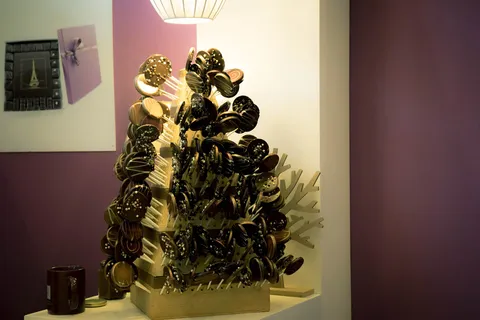
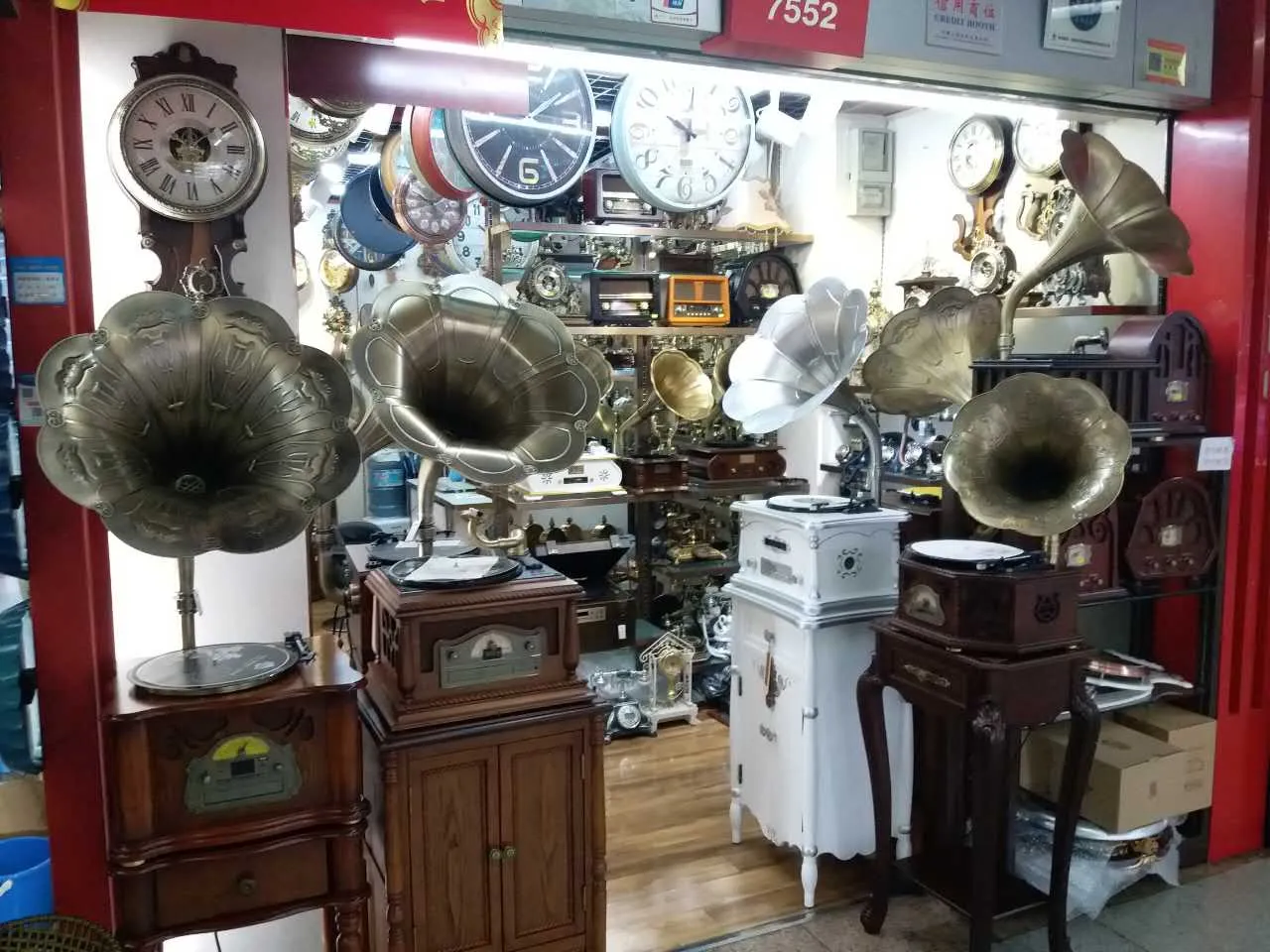 One stall, one obsession — a single booth selling nothing but gramophones and clocks. There are tens of thousands more like it.
Who actually goes to Yiwu?
Two very different crowds:
- Buyers and importers — the main reason the city exists. Wholesalers, e-commerce sellers, market traders and sourcing agents from Africa, the Middle East, Latin America, Russia and beyond come to place bulk orders, often containers at a time.
- Curious travellers — a smaller but growing group who come for the sheer spectacle. You don’t have to buy a thing to find it fascinating.
If you’re in the second group, set expectations: this is a working wholesale market, not a tourist attraction. There’s no light show, no curated “experience” — just the raw machinery of global trade, which is exactly the appeal.
Getting to Yiwu
Yiwu is extremely well connected for a mid-sized city, precisely because the world needs to reach it.
- High-speed rail is the easiest option. Yiwu Station (义乌站) sits on the busy Shanghai–Hangzhou–Kunming line:
- From Hangzhou — about 40–75 minutes.
- From Shanghai (Hongqiao) — about 1.5–2.5 hours depending on the train.
- From Ningbo, Nanjing or Yiwu’s neighbours — a quick hop.
- Book through Trip.com or in-station; see our high-speed rail guide for how to buy tickets as a foreigner.
- Yiwu Airport (YIW) has domestic flights to major Chinese hubs — handy if you’re coming from further afield. Compare with the train; see domestic flights in China.
- Flying international? Most visitors land at Shanghai (PVG/SHA) or Hangzhou (HGH) and take the train in. Hangzhou is the closest major airport. Read arriving at Chinese airports so immigration and customs go smoothly.
From Yiwu Station, the Futian Market is a short taxi or Didi ride away — every driver knows “国际商贸城” (International Trade City).
Inside the International Trade City:
the five districts
The main market is laid out as five numbered districts (区), each focused on broad categories. Knowing roughly where your goods live saves hours — the place is genuinely too big to wander aimlessly.
- District 1 — toys, artificial flowers, jewellery and accessories, hair ornaments.
- District 2 — hardware, tools, luggage, umbrellas, electronics and appliances.
- District 3 — stationery, sports goods, cosmetics, glasses, zippers and clasps.
- District 4 — socks, gloves, scarves, hats, everyday textiles and daily-use goods.
- District 5 — imported goods, bedding, car accessories and higher-end lines.
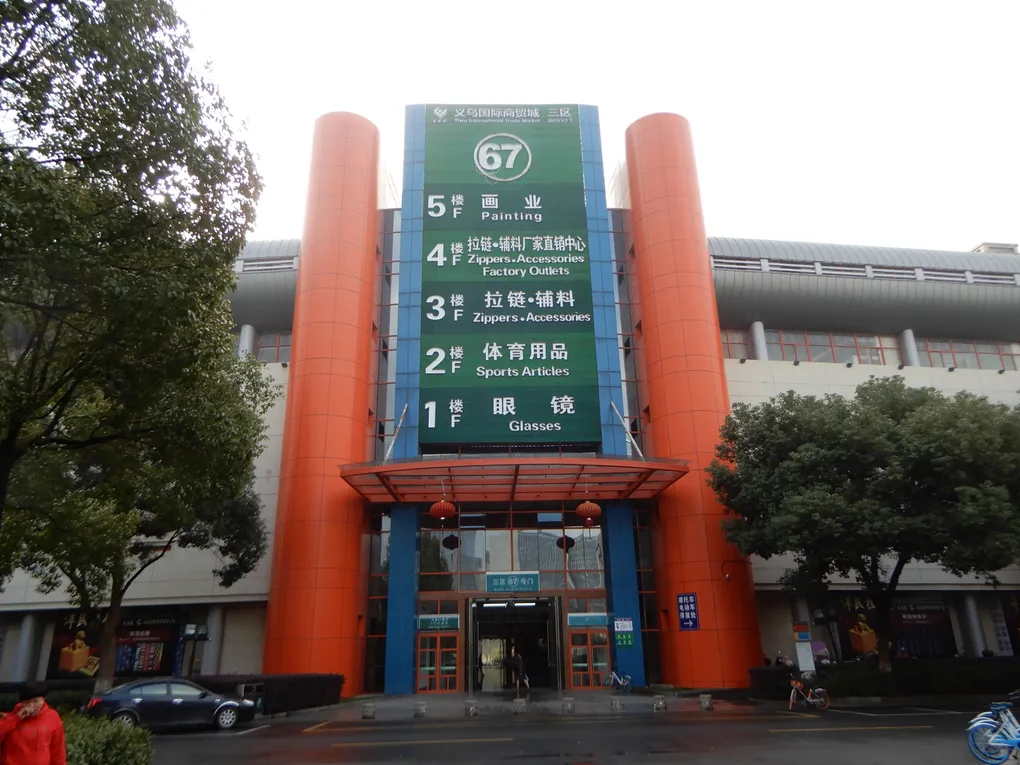
Each multi-storey building stacks sub-categories floor by floor, with a giant directory at every gate (the orange-pillared “67” entrances are a Yiwu landmark in themselves). Opening hours are roughly 09:00–17:00 daily, though many booths wind down in the late afternoon — go in the morning for full energy and full shelves.
There are other markets too: the Huangyuan (篁园) garment market, the Binwang (宾王) market, and the International Production Material Market for raw materials and machinery. For most visitors, the International Trade City alone is more than a full day.
How buying actually works
This is where Yiwu surprises people. It’s a wholesale market, so the rules differ from a tourist bazaar:
- Booths are showrooms, not shops. Each stall displays samples; orders are shipped from a warehouse. You’re meeting the factory’s sales rep, not browsing stock to carry away.
- Minimum order quantities (MOQ) apply. Some sellers will do a single carton; many want a minimum number of pieces, boxes or a full case. Small “one-piece” retail purchases are possible at some stalls but not the norm.
- Prices are low and fairly fixed. Yiwu’s margins are razor-thin, so there’s far less theatrical haggling than at a Beijing pearl market — but larger orders earn better unit prices, and that’s where negotiation happens. (If you want the haggling sport, see markets & bargaining in China.)
- Take samples and business cards. Serious buyers collect samples and the seller’s card (every booth has a number, e.g. District 3, Gate 5, 2F, Booth 7552), then compare and place orders later.
- Pay by Alipay or WeChat Pay for samples and small buys; large orders go by bank transfer or through an agent. Set up mobile payments before you arrive — our payments guide walks foreigners through it.
Should you use a sourcing agent?
For a real buying trip, yes — usually. A Yiwu sourcing/buying agent (everywhere in the city) will, for a commission or daily fee:
- Translate and walk the market with you to find the right booths fast.
- Consolidate orders from many stalls into one shipment.
- Handle quality inspection, packing, the export warehouse, customs paperwork and a freight forwarder to your country.
This “one order, many factories, one container” model is the whole reason Yiwu works for small importers. If you’re buying seriously, line up a reputable agent before you go.
Getting it home
- Small quantities can ship by international courier straight from many booths.
- Bulk orders go via a forwarder by sea (cheapest, slowest) or air, usually arranged by your agent.
- Check your home country’s import duties and customs limits before you commit — and keep all invoices.
Where to stay
Stay near Futian Market so you can walk back to your hotel to drop samples between buildings. The area around the International Trade City and Chouzhou North Road is packed with business hotels at every price, many used to foreign buyers (English-speaking front desks, breakfast that runs the gamut from congee to hummus).
Compare rates on Booking.com, Agoda or Trip.com and book one within walking distance of the market — it’s the single biggest quality-of-life upgrade for a buying trip. For Chinese chains, the home-grown Huazhu brands (Hanting, Ji, Orange) are reliable and cheap.
Where to eat
Decades of traders from around the world have made Yiwu one of the most quietly cosmopolitan food cities in China. Around Exotic Street (异国风情街) and the Binwang area you’ll find genuine Middle Eastern, Turkish, Arabic, Korean and Indian restaurants run by long-settled expat families — proper lamb kebabs, mezze and biryani alongside excellent local Zhejiang food. After a day of fluorescent-lit aisles, a plate of hand-pulled noodles or shawarma is the reward.
When to go
- Avoid Chinese New Year. The market — and most of the city — shuts for one to two weeks around the lunar new year (usually late January/February) and is quiet for a while after. The single biggest scheduling mistake foreigners make. Check dates against our best time to visit China guide.
- The Yiwu Fair (China Yiwu International Commodities Fair) runs in late October — the city’s biggest trade event, with extra exhibitors but busier hotels.
- Go on a weekday morning for the fullest, liveliest market.
Practical tips for foreign visitors
- Language — major booths often have an English- or Arabic-speaking salesperson, and the directories are bilingual, but a translation app (Pleco, or your phone’s translator) smooths everything. See our must-have apps.
- Stay connected — you’ll be looking up specs, exchange rates and maps constantly. Sort an eSIM for China and, if you need Google/WhatsApp/Instagram for work, a working VPN before you land.
- Visas — most short buying trips run on a tourist visa or visa-free transit, but frequent buyers often get an M (business) visa. Check your situation in our visa requirements by nationality, and sort it early via iVisa if needed.
- Wear comfortable shoes. You will walk kilometres of polished floor. This is not a joke.
- Online first — the official Yiwugo platform lets you scout categories and booths online before you fly, so you arrive with a hit-list.
Is it worth visiting if you’re not a buyer?
Honestly — yes, if “the largest market on Earth” sounds like your kind of strange. A half-day inside the International Trade City is one of the most genuinely only-in-China experiences there is: the scale of global manufacturing made suddenly, dizzyingly visible. Pair it with nearby Hangzhou (see our Hangzhou itinerary) and you get China’s loveliest lake and its loudest marketplace in one trip.
And if you are buying — or want help arranging a reputable agent, translator or factory visit before you arrive — get in touch and we can point you the right way.
Hero photo: a Yiwu International Trade Market directory entrance by Whisper of the heart, CC BY-SA 4.0; gramophone stall by Muzzleflash, CC0 — both via Wikimedia Commons.